

NATO DIANA debuts second dual-use cohort to UK ecosystem at London launch event
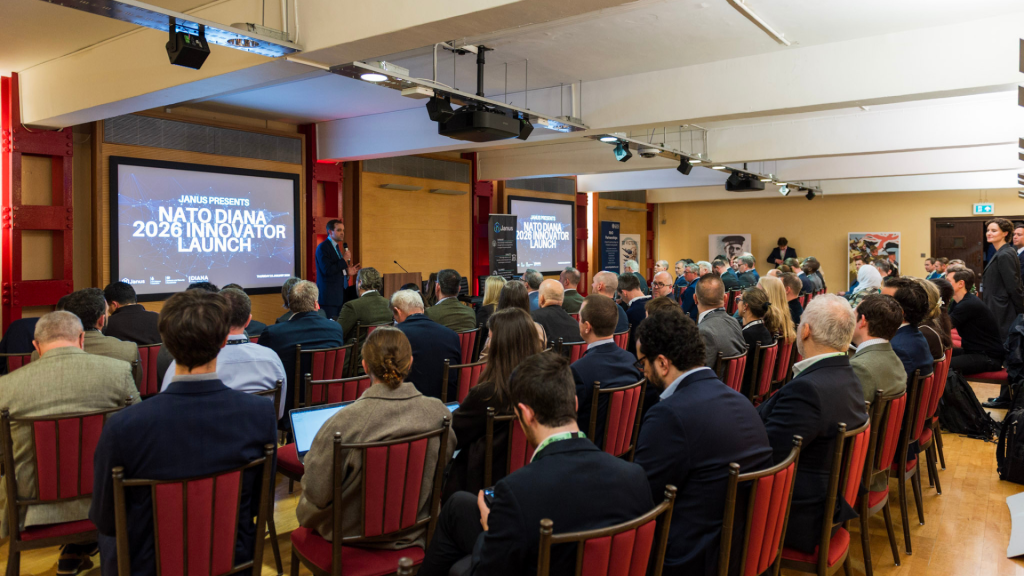
NATO DIANA debuts second dual-use cohort to UK ecosystem at London launch event Official press release 5 February 2026 Eight innovators commence mission to bolster NATO’s resilience in Contested Electromagnetic Environments LONDON (5 February 2026): Janus Allies (Janus), the UK Accelerator for NATO’s Defence Innovation Accelerator for the North Atlantic (DIANA), in partnership with UK Defence Innovation (UKDI), has welcomed a new cohort of innovators. In 2025 NATO DIANA received a record-breaking 3,680 submissions, this latest NATO DIANA cohort emerged from a highly selective process, placing them in roughly the top 4% of applicants and among the most competitive dual-use innovators in the Alliance. The launch event for the 2026 NATO DIANA Cohort was hosted at the Churchill War Rooms, highlighting the link between historic resilience and today’s defence innovation realities. At the event, Lieutenant General Sir Ralph Wooddisse, KCB, CBE, MC, Commander of the NATO Allied Rapid Reaction Corps (ARRC), spoke about the innovation and adaptation needed for the warfighter. The evening then continued with remarks on building global advantage through collaboration, exports, and innovation, before concluding with John Cunningham, Director of Defence Innovation at the Ministry of Defence, on accelerating capabilities to the front lines. “Throughout my time in the Royal Air Force, I was a direct beneficiary of some of the UK’s most cutting-edge technologies, witnessing first-hand the transformative power of collaboration between technologists, academics, defence industry personnel and policymakers. The purpose of UK Defence Innovation is to place innovative solutions into the hands of the warfighter at speed and the pace at which innovation must be developed and deployed into capability is only accelerating. The opportunity for rapid improvement lies in strategically exploiting commercial technologies through a unified public-private sector approach. The NATO DIANA challenge, UKDI and UK Accelerator embody this shift, adopting a ‘fail fast’ startup mentality to test emerging capabilities at pace. The NATO DIANA programme has already generated incredible successes within the dual-use defence sector, sending a clear message of innovation, strength and agility.” John Cunningham, Director of UK Defence Innovation within the Ministry of Defence This year, Janus, the UK Accelerator is uniquely focused on solutions for Contested Electromagnetic Environments, one of the ten priority areas defined by NATO DIANA. The electromagnetic spectrum serves as an invisible frontline for adversaries to disrupt communication channels and mask emerging threats, and, in turn, represents an all-important battle for information control. Commencing a six-month programme to rapidly integrate their technologies into the UK dual-use sector, and with talent from seven different nations across the NATO alliance, the innovators are: Slipstream Design, United Kingdom – SME delivering secure, reconfigurable digital-RF sensing and communications for contested electromagnetic environments. CX2 Inc., United States of America– delivering spectrum dominance to the battlefield by providing AI-enabled hardware and software that characterises, disrupts and defends the electromagnetic domain in contested environments. FOSSA Systems, Spain– delivering sovereign, multi-mission LEO satellite constellations that combine secure low-power SatCom (IoT/D2D) with space-based signals intelligence (SIGINT). LSMedical, Estonia– a deep-tech materials science company founded to solve one of the most critical strategic vulnerabilities facing NATO and its allies: the dependence on rare earth permanent magnets. Oledcomm, France– a deep-tech pioneer and a global leader in optical wireless communications, specialising in Li-Fi (Light Fidelity) technology. SDQ Solutions Canada– future-proofing the next generation of global navigation: Quantum-Resistant Anti-Spoofing Solution for Assured Positioning, Navigation and Timing. Tern AI Inc, USA – Independently Derived Positioning System (IDPS™) provides assured, live vehicle positioning in contested and degraded environments operating without GNSS, satellites, signals, infrastructure or spectrum. Testnor AS, Norway– developing a modular, dual-use platform designed to validate advanced technologies in GNSS-denied, electromagnetically contested, and extreme conditions. “Overcoming modern adversaries demands the right technological capabilities being deployed by the right people at the right time. By aligning mission with margin, the NATO DIANA accelerator ensures that startups don’t just innovate, but scale to help us gain a competitive advantage. The programme created by NATO DIANA supports the Government’s Strategic Defence Review, with a focus on accelerating innovation, enabling faster access than traditional procurement strategies and strengthening industrial defence capabilities. At Janus, we are committed to bridging the gap between innovation and deployment, ensuring that technologies are battlefield-ready to protect our allies.” Tanya Suarez, CEO of IoT Tribe and lead of the Janus accelerator NATO DIANA has been running accelerators across Allied nations for three years, with the UK Accelerator, delivered by Janus on behalf of UDKI, launching two years ago. The fist cohort, launched in 2025, is already making headlines across the ecosystem: Slovakia-founded RV Magnetics, which specialises in developing and manufacturing the world’s smallest passive sensors. A year on from joining the UK Accelerator, RV Magnetics has now successfully tested its flagship ‘Microwire’ technology at the National Physics Laboratory and has already secured strategic defence contracts. AI Verse has secured €5 million in new fundingto scale its synthetic data platform for high‑performance computer vision. The round was led by Supernova Invest, with participation from CAIT, Amundi AAI4, Creazur and returning investors Innovacom and Bpifrance Digital Venture. “This milestone is a strong signal of confidence in our technology and our team. It also builds on the momentum we’ve gained through programmes like NATO DIANA, which have helped accelerate our growth and refine our approach to defence partners. Grateful to all our investors and collaborators for believing in what we’re building.” AI Verse’s Vice President of Sales, Ilya Ostrovsky The 2026 cohort will follow the same path of real‑life deployment, testing exercises and supply‑chain integration to accelerate technology adoption across the dual‑use ecosystem and, ultimately, across NATO. In this way, the UK Accelerator delivered by Janus, on behalf of NATO DIANA and in collaboration with UKDI, is helping to support NATO’s innovation and technology strategy and the UK’s defence innovation goals. “We have a collective responsibility to strengthen our Armed Forces, defend our nations, and protect our people – that is our purpose. At NATO DIANA, we exist to turn innovation into impact, connecting government, industry and cutting-edge innovators to deliver the capabilities our warfighters need to protect themselves and others. When these partnerships work well, the